
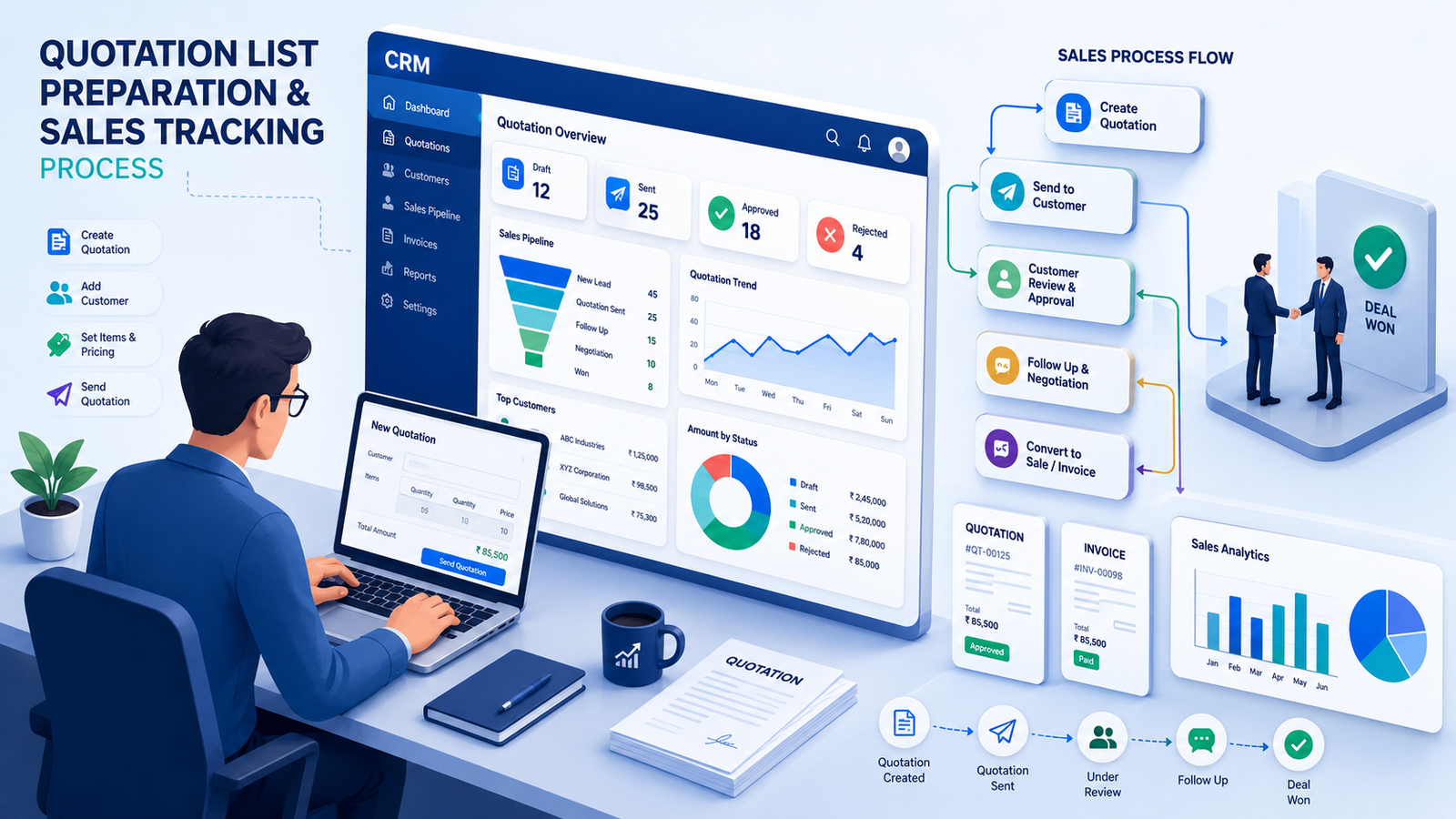
Quotation List Preparation and Sales Tracking Process: Complete Guide (2026)
Every successful business relies on a well-organized quotation and sales tracking system. Preparing accurate quotations and monitoring customer interactions throughout the sales cycle directly impact conversion rates, revenue growth, and customer satisfaction. Businesses that master this process respond to inquiries faster, maintain consistent pricing, and close more deals.
A quotation list is more than just a price document—it serves as a comprehensive record of customer requirements, product details, pricing, taxes, discounts, and follow-up activities. When managed correctly, it becomes your most valuable sales tool for improving business performance and revenue generation.
This complete guide covers every aspect of quotation preparation and sales tracking, from customer requirements analysis to order confirmation and payment collection.
What is a Quotation List?
A quotation list is a systematic collection of quotations prepared for customers based on their specific requirements. It serves as both a sales document and a tracking tool that records pricing, product specifications, payment terms, delivery schedules, and customer communication history.
- Respond to customer inquiries 50% faster
- Improve quotation to order conversion rates by 30-40%
- Maintain consistent and competitive pricing across all customer segments
- Reduce pricing errors and discrepancies
- Track pending quotations and follow-up activities automatically
- Analyze customer behavior and buying patterns
- Build customer trust through professional documentation
- Support data-driven sales forecasting and revenue planning
7-Step Process to Prepare Professional Quotations
Follow these essential steps to create quotations that convert inquiries into sales orders efficiently.
Begin by collecting complete information about the customer's needs before preparing any quotation.
- Product/Service Specifications: Exact details of what the customer needs
- Quantity Required: Precise volume and unit specifications
- Delivery Timeline: When the customer needs the products or services
- Budget Constraints: Customer's price expectations and budget range
- Payment Preferences: Preferred payment methods and terms
- Special Requirements: Any customization or special conditions needed
Choose the correct products or service options that match customer requirements exactly.
- Review product catalog and availability
- Verify product specifications match customer needs
- Check stock levels for immediate delivery capability
- Identify alternative options if primary choice is unavailable
Prepare detailed pricing breakdown including all applicable charges:
- Base Product Price
- Quantity Discounts
- Volume Rebates
- Promotional Offers
- Shipping/Delivery Costs
- Packaging Charges
- Insurance Fees
- GST/Taxes
Double-check every calculation and detail before sending the quotation:
- ✓Quantity Verification — Confirm all item quantities match customer request
- ✓Price Accuracy — Verify base prices, discounts, and final amounts
- ✓Tax Calculations — Ensure GST and other taxes are calculated correctly
- ✓Payment Terms — Confirm payment conditions are clearly specified
- ✓Delivery Schedule — Verify feasibility of promised delivery date
Create a well-formatted quotation with all essential information clearly presented. Use professional templates that reflect your brand image and include all required compliance information.
Deliver the quotation promptly through the customer's preferred communication channel:
- Email with PDF Attachment: Professional and trackable
- Online Portal: For repeat customers with account access
- CRM Software: Automated tracking and follow-up
- Direct Communication: Discuss key terms verbally for large orders
Store the quotation in your tracking system with complete details for follow-up and analysis:
- Quotation reference number
- Customer name and contact details
- Quote amount and validity date
- Product specifications and quantities
- Assigned sales representative
- Follow-up schedule and status
Essential Components of a Professional Quotation
Every quotation should include comprehensive information organized in a clear, professional format:
| Section | Required Information | Purpose |
|---|---|---|
| Business Information | Company name, address, contact details, GST number, website | Establish credibility and provide seller identification |
| Customer Details | Name, company, contact number, email, billing/delivery address | Ensure accurate delivery and communication |
| Quotation Header | Quote number, date, valid until date, sales representative | Identify document for tracking and validity |
| Product Details | Product name, description, quantity, unit price, specifications | Clearly specify what customer is purchasing |
| Pricing Breakdown | Subtotal, discounts applied, GST/taxes, final amount | Provide transparent cost breakdown |
| Terms & Conditions | Payment terms, delivery timeline, warranty, return policy | Establish clear business terms and expectations |
| Special Notes | Customization details, volume discounts, promotional offers | Highlight unique value propositions |
Complete Sales Tracking Process
After sending a quotation, implement a systematic tracking process to monitor progress through the entire sales cycle:
Capture customer inquiries from all channels:
- Website contact forms and inquiries
- Email requests and messages
- Phone calls and customer meetings
- Trade shows and industry events
- Referrals and existing customer networks
Prepare and send professional quotations:
- Analyze customer requirements thoroughly
- Prepare accurate, competitive pricing
- Generate professional quotation document
- Send within 24 hours of inquiry
- Record quotation in tracking system
Contact customers to advance the sales process:
- Answer questions and address concerns
- Provide additional product information
- Offer technical specifications and samples
- Address pricing objections with alternatives
Engage in productive discussions when customers request modifications:
- Negotiate pricing or discount terms if appropriate
- Adjust delivery schedules based on customer needs
- Modify product specifications or quantities
- Clarify payment terms and conditions
- Prepare revised quotations promptly
Convert approved quotations into formal sales orders:
- ✓Sales Order Issuance: Create formal order document with updated order number
- ✓Inventory Reservation: Reserve stock and confirm availability
- ✓Order Confirmation Email: Send confirmation with order details to customer
- ✓Production/Procurement Trigger: Initiate manufacturing or purchase processes
Generate accurate invoices for billing and accounting:
- Create invoice with order reference
- Include all product details and pricing
- Calculate GST and other applicable taxes correctly
- Specify payment due date and methods
- Send via email and maintain records
Monitor payments and maintain healthy cash flow:
- Track payment status and due dates
- Send payment reminders before due dates
- Follow up on overdue invoices promptly
- Reconcile payments with invoices
- Maintain detailed payment records
Analyze quotation performance and sales metrics:
- Calculate quotation to order conversion rate
- Identify high-performing products and customers
- Track average deal size and sales cycle length
- Analyze reasons for lost quotations
- Generate monthly and quarterly sales reports
Best Practices for Superior Quotation Management
Implement these industry-proven strategies to maximize conversion rates and customer satisfaction:
Consistent Formatting
Use standardized quotation templates that reflect brand identity and include all required information consistently.
Unique Reference Numbers
Assign sequential quotation numbers for easy tracking, organization, and reference in customer communications.
Updated Pricing
Maintain current pricing information in your system. Review and update prices regularly to reflect market changes.
Complete Terms & Conditions
Include comprehensive payment terms, delivery conditions, warranty details, and return policies in every quotation.
Regular Follow-ups
Contact customers consistently using a planned follow-up schedule. Missing follow-ups directly reduces conversion.
Secure Storage
Store all quotations securely in organized folders with access controls. Maintain backup copies for compliance.
- 1Quotation Analysis: Review all quotations sent in the month
- 2Conversion Metrics: Calculate quotation to order conversion percentage
- 3Lost Quote Analysis: Investigate why quotations were rejected
- 4Product Performance: Identify which products converted best
- 5Pricing Review: Assess pricing competitiveness and margins
- 6Team Performance: Evaluate sales team quotation quality and follow-up effectiveness
Common Challenges and Solutions
Address these frequent business challenges affecting quotation management:
Solution: Implement a centralized quotation management system where all quotations are stored in one organized database with proper backup procedures.
Solution: Maintain a quotation register with unique reference numbers. Search the database before preparing new quotations for repeat customers.
Solution: Use quotation software with automated calculations. Implement a verification checklist requiring two-person approval for high-value quotations.
Solution: Use CRM software that automatically reminds sales staff about pending follow-ups. Set follow-up tasks with specific dates and responsible persons.
Solution: Implement business software that automates quotation generation, calculations, and customer notifications. This frees sales time for actual customer engagement.
How Digital Tools Improve Quotation Management
Modern business software transforms quotation and sales tracking from manual, error-prone processes to automated, efficient systems:
- Automatic quotation number generation
- Template-based document creation
- Customer database integration
- Automatic price lookups
- Tax calculation automation
- Real-time quotation status tracking
- Automated follow-up reminders
- Conversion rate analytics
- Comprehensive sales reports
- Customer communication history
| Feature | Benefit | Impact |
|---|---|---|
| Automatic Email Sharing | Send quotations directly from software to customer email | Instant delivery, professional appearance, tracking enabled |
| GST Auto-Calculation | System automatically calculates applicable taxes | Eliminates calculation errors, ensures compliance |
| Inventory Integration | Real-time stock availability check during quotation | Prevents over-promising, ensures delivery reliability |
| Customer Database | Centralized customer information and history | Faster quotation preparation, consistent communication |
| Payment Tracking | Monitor quotation to invoice to payment lifecycle | Improved cash flow, reduced payment delays |
| Analytics Dashboard | Visual reports on conversion rates and sales metrics | Data-driven decision making, improved strategy |
Master Quotation Management
Learn proven strategies to increase quotation conversion rates by 30-40% and build a systematic sales tracking process.
Professional Templates
Ready-to-use quotation templates for all industries and business types
Tracking Systems
Complete tracking spreadsheets and monitoring guidelines
Follow-up Strategies
Proven follow-up schedules and communication templates
Expert Guidance
Direct support from sales and business management professionals
Frequently Asked Questions
How long is a quotation typically valid?
Most quotations are valid for 15-30 days, depending on market conditions and product pricing volatility. Specify the validity date clearly on every quotation to create urgency and manage customer expectations.
What's the ideal quotation to order conversion rate?
Average conversion rates range from 20-40% depending on industry and sales process efficiency. Well-managed quotation systems typically achieve 30-50% conversion rates, significantly higher than industry average.
How often should I follow up on pending quotations?
Follow up within 2-3 days for initial inquiry response, again at 7-10 days if no response, and finally at 20-25 days before validity expires. For high-value quotes, more frequent contact is appropriate.
Should quotations include payment terms?
Yes, absolutely. Every quotation must clearly specify payment terms (e.g., 30% advance, 70% before delivery), accepted payment methods, and any applicable discount for early payment.
Can quotations be revised after sending?
Yes, send revised quotations whenever customer requirements change. Always use a new quotation number, mark it as "Revised," and reference the original quotation number for clarity.
What should I do with rejected quotations?
Analyze rejection reasons to improve future quotations. Follow up to understand objections, offer alternatives, and maintain the relationship for future opportunities.
Conclusion
Quotation list preparation and sales tracking are fundamental pillars of business growth. A well-organized quotation system directly increases conversion rates, improves cash flow, and strengthens customer relationships. Businesses that master this process consistently outperform competitors in revenue growth and customer satisfaction.
Start implementing the 7-step quotation process today, establish a systematic follow-up schedule, and track every quotation through to conversion or closure. Within 90 days, you'll see significant improvement in conversion rates, faster sales cycles, and stronger customer relationships. Use this guide as your reference document and commit to continuous improvement of your quotation and sales tracking processes.
Why This Quotation System Works
At Sales Excellence Hub, we've tested these quotation and sales tracking strategies with hundreds of businesses across multiple industries:
Industry-Tested Methods
Our quotation and tracking strategies are based on real-world implementation with measurable results and continuous refinement.
Conversion Rate Improvement
Implementation of this complete system typically results in 25-40% improvement in quotation to order conversion within 90 days.
Explore More Sales Resources
Tracking Pending Payments in TallyPrime
Learn how to monitor outstanding receivables and payables in TallyPrime to improve cash flow, avoid overdue payments, and manage customer collections efficiently.
📊 TallyPrime GuideAssets and Liabilities in TallyPrime
Learn how to manage assets and liabilities in TallyPrime, track business finances accurately, monitor account balances, and generate financial reports for better decision-making.
🤝 paymentstracking pending payments
Guide to tracking pending payments on tally prime