
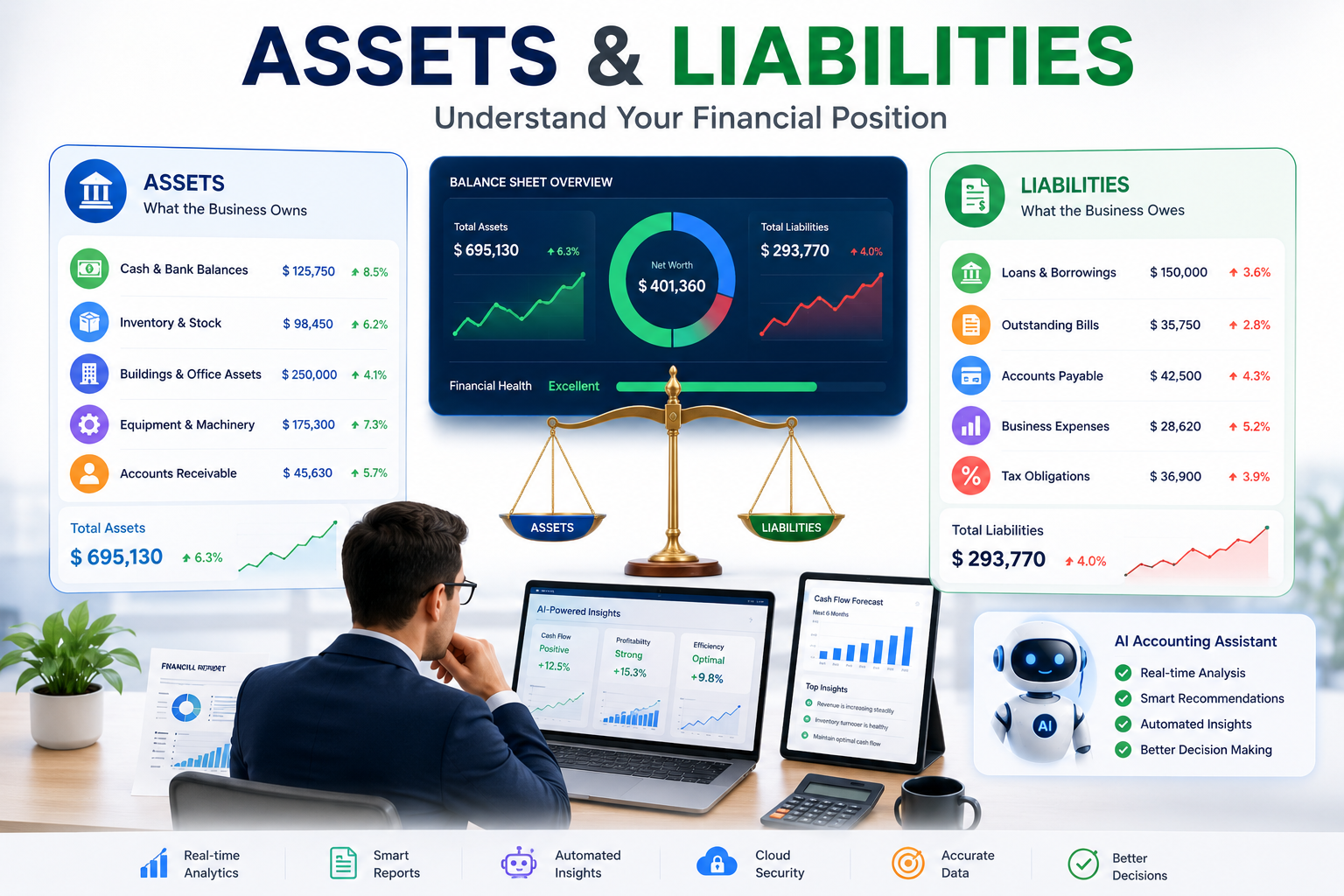
Assets are what a business owns, while liabilities are what it owes. Both are recorded on the balance sheet, and almost every financial transaction affects one or both. That is why they sit at the centre of accounting, providing a clear picture of a business's financial position at any given point in time.
A profit figure alone cannot tell you whether your business is truly financially healthy. Two businesses can show the same net profit — but one may be sitting on crippling debt while the other is debt-free. Assets and liabilities reveal the full story that income statements cannot.
What Are Assets?
The Foundation
Assets are resources that a business owns or controls and expects to generate future economic benefits from. They can include physical items such as machinery and buildings, as well as financial resources like cash and receivables. Assets play an important role in supporting business operations, generating revenue, and contributing to overall business value.
Every asset on your balance sheet represents a decision your business made — a piece of equipment purchased, a product stocked, a customer billed. Understanding what each asset contributes helps you deploy resources more effectively.
Types of Assets
Current vs Non-Current
Assets are classified into two types based on how quickly they can be converted into cash:
These fund daily operations and are expected to be used or converted within a single financial year. Common examples include:
- Cash and cash equivalents
- Trade receivables (money owed by customers)
- Stock in hand / inventory
- Short-term investments and prepaid expenses
These are long-term resources held for more than one financial year to support operations and generate revenue over time. They include:
- Tangible assets: Land, buildings, plant, and machinery
- Intangible assets: Patents, trademarks, and goodwill
- Long-term investments and capital work in progress
What Are Liabilities?
Financial Obligations Explained
A liability is a financial obligation that a business owes to an outside party, whether through payment of money, delivery of goods, or rendering of services. Liabilities are defined by the obligation they create, not the form they take.
Goods bought on credit, salaries earned but not yet paid, and advance payments collected from customers all qualify as liabilities. They are recorded alongside equity on the balance sheet, and together they explain how the business's assets have been funded.
Liabilities are not inherently bad. Strategic use of borrowings — such as a term loan to buy machinery that generates revenue — can accelerate growth. The risk arises when liabilities grow faster than the assets they fund, squeezing equity and tightening cash flow.
Types of Liabilities
Current vs Non-Current
Liabilities are classified into two types based on when they are due for repayment:
These must be settled within the current financial year. Losing track of these can cause cash flow problems even for an otherwise profitable business. Examples include:
- Trade payables (amounts owed to suppliers)
- Short-term borrowings and overdrafts
- Outstanding wages and salaries
- Taxes payable (GST, TDS, advance tax)
These extend beyond twelve months and require longer-range financial planning. They are closely watched by lenders when a business applies for additional credit:
- Term loans from banks and NBFCs
- Long-term lease obligations
- Deferred tax liabilities
- Bonds and debentures issued
What Is the Difference Between Assets and Liabilities?
Side-by-Side Comparison
Both appear on the balance sheet but serve opposite roles. The table below breaks down the key differences:
| Basis | Assets | Liabilities |
|---|---|---|
| Meaning | Resources owned or controlled by the business | Financial obligations owed to external parties |
| Nature | What the business owns | What the business owes |
| Balance Sheet Position | Presented separately as part of total assets | Presented separately as part of liabilities and equity |
| Impact on Net Worth | Increases net worth | Decreases net worth |
| Examples | Cash, inventory, machinery, receivables | Bank loans, trade payables, tax payable |
How Do Assets and Liabilities Determine Net Worth?
The Accounting Equation
On a balance sheet, equity is recorded first, followed by non-current and current liabilities. The assets are recorded below. The combined total of equity and liabilities must always equal total assets.
This balance is enforced by the fundamental accounting equation:
That ₹20 lakh is the owner's residual stake in the business after all obligations are met.
The trend of these figures over time provides valuable insight into financial health. If liabilities increase without a corresponding increase in assets, equity may decline. Conversely, when assets grow faster than liabilities, equity generally strengthens. A profit figure alone cannot tell you that — but a balance sheet reveals the whole story.
A business that grows revenue while quietly accumulating debt faster than assets is not getting stronger — it's getting more fragile. The balance sheet is the only place that makes this visible before it becomes a crisis.
What Is the Relationship Between Assets and Liabilities?
Financial Ratios That Matter
Financial ratios help interpret balance sheet data by expressing the relationship between assets and liabilities in crisp, measurable values:
Formula: Current Assets ÷ Current Liabilities
This ratio reveals a business's ability to meet its financial obligations due within one year. A ratio above 1 indicates that current assets exceed current liabilities — a favourable position. Readings below 1 suggest the business may not have sufficient liquid resources to cover short-term obligations.
Comfortable range: 1.5 to 2 — though the ideal range differs by industry.
Formula: Total Liabilities ÷ Total Assets
This tells you how much of the business's assets have been paid for with borrowed money. A ratio of 0.4 means 40% of total assets are debt-financed — the remaining 60% sits on stronger footing.
When this number is pushed higher, creditors take notice — a larger share of the asset base is now exposed to repayment risk, reducing financial resilience.
- Automatically maintains accurate asset and liability records as transactions occur
- Balance sheet stays current in real time — no manual updates required
- Financial ratios calculated instantly from live data
- Ageing reports show receivables and payables at a glance
- Single connected system — invoicing, payments, banking, and reporting in one place
Track Assets & Liabilities in Real Time
Join 7 million+ businesses across India managing their balance sheet, accounting, and GST in one connected system.
Live Balance Sheet
Assets, liabilities, and equity updated automatically with every transaction
Financial Ratios on Demand
Current ratio, debt-to-asset, liquidity — all computed from live data
GST & Compliance Built In
GSTR-1, GSTR-3B, e-invoicing, and TDS — handled automatically
Real-Time Reports
P&L, Cash Flow, Receivables Ageing — always current, never stale
Conclusion
Assets and liabilities are not just entries in a ledger. They reflect the financial decisions a business has made — and shape the decisions it will make. A business that carefully tracks both can spot trouble early and plan from a position of clarity rather than scrambling to react.
The relationship between assets and liabilities, expressed through ratios like the current ratio and debt-to-asset ratio, gives business owners a language for evaluating financial health that goes far beyond revenue and profit.
TallyPrime helps businesses maintain accurate asset and liability records within a single connected system, keeping the balance sheet current as transactions occur — so you always know exactly where your business stands. Start your 7-day free trial and experience the clarity of real-time financial visibility from day one.