
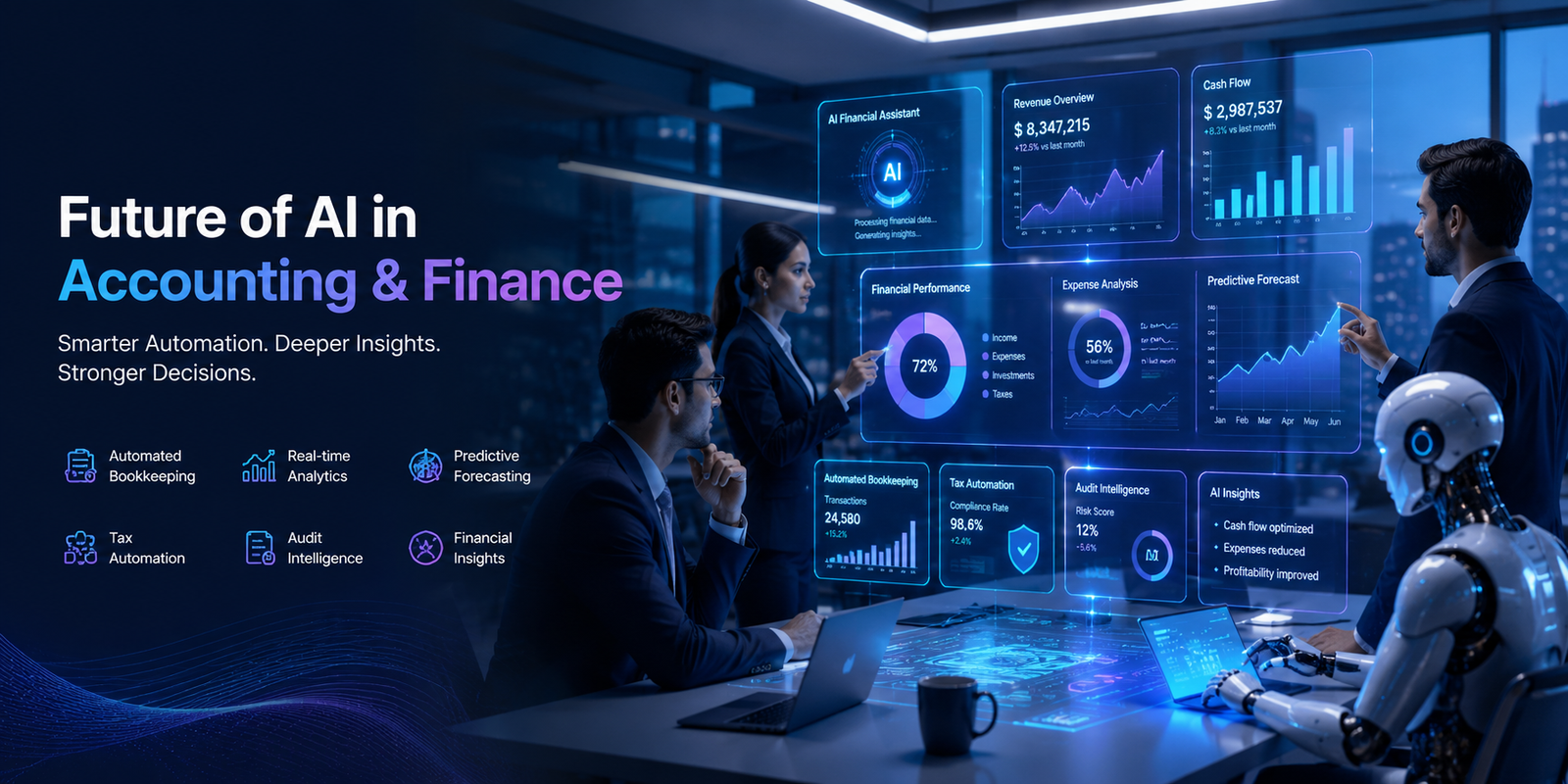
Artificial intelligence is reshaping accounting and finance by automating invoice processing, improving tax compliance, enabling faster forecasting, and strengthening fraud detection. These capabilities are already being used by businesses to reduce manual effort and improve accuracy in financial operations.
As AI adoption expands and regulatory scrutiny increases, understanding these evolving trends has become essential for effective and compliant financial management. The businesses that study these shifts early will be far better positioned than those forced to adapt under pressure.
AI is moving from early adoption to mainstream use. For most Indian businesses, the question is no longer whether AI in accounting and finance will matter — but how quickly they can adapt before compliance demands, real-time enforcement and shifting talent expectations make it unavoidable.
1. Agentic AI for Autonomous Workflows
What Is It?
Agentic AI will likely become a key driver for workflow automation in finance. Unlike today's tools that assist with single tasks, future AI systems could manage entire end-to-end workflows — from monitoring receivables and following up with customers to updating records and escalating exceptions, all without human instruction at each step.
Organisations may need to overcome challenges related to legacy system integration, data readiness, and governance frameworks before these capabilities can be deployed at scale. Without clean, structured data, agentic AI cannot function reliably.
As these barriers are addressed, less time will be spent on supervising routine tasks and human involvement will be reserved for judgement-based decisions and exception handling — freeing finance teams for higher-value work.
2. AI-Driven Portfolio Optimisation
Strategic Reshaping Is Now Realistic
Financial institutions are entering a period in which portfolio reshaping has become a realistic strategic option, with valuations, capital availability, and investor expectations now aligned. As AI-driven portfolio analysis becomes more sophisticated, institutions can pursue value creation in three directions:
- Strengthen core businesses — deepen competitive moats in existing areas
- Expand into growth areas — identify high-potential segments using AI-driven pattern recognition
- Divest underperforming assets — exit assets that no longer fit strategic objectives
AI makes this analysis faster, more data-driven, and less dependent on costly external consulting, giving mid-market firms access to capabilities once reserved for large institutions.
3. Cloud-Based Accounting and AI Integration
The Data Backbone of Modern Finance
Cloud-based accounting will likely move from a record-keeping platform into the data backbone of AI-driven finance. This is one of the most important infrastructure shifts businesses can make today.
- AI agents with real-time access to financial data can support compliance activities as transactions happen
- Unusual activity is identified and escalated to management automatically, rather than discovered in monthly reviews
- Businesses gain greater control and continuous visibility over their financial operations
With real-time access to information, AI agents will be able to support compliance activities, identify unusual activity, and escalate issues to management — making reactive finance teams a thing of the past.
4. AI and Cybersecurity in Finance
Security Must Scale with AI Adoption
As the finance function becomes increasingly dependent on AI, every deployed agent will need clear identity boundaries, access controls, and protection against external threats. Without them, the same systems meant to improve efficiency can become entry points for fraud or data breaches.
AI agents that have broad access to financial systems without proper governance can be exploited. A compromised agent could silently alter records, redirect payments, or exfiltrate sensitive data before any human notices the anomaly.
- Identify patterns in transactions that humans miss due to scale or speed
- Speed up threat response from hours to seconds
- Anticipate attacks in real time using predictive modelling
- Monitor agent behaviour continuously and flag anomalies before they escalate into failures
5. AI as a Human Collaborator, Not a Replacement
The Collaboration Model Is Winning
While concerns about job displacement continue, the future of AI in finance is expected to be centred on collaboration rather than replacement. This framing is important for business leaders managing team concerns and talent strategy.
- AI takes on routine analysis, reconciliation, and information processing
- Humans focus on strategy, judgment, and client relationships
- Small teams can take on work that previously required significantly more headcount
- The most valuable professionals become those who know how to direct and interpret AI output
The key insight for employers is this: AI does not reduce the need for talent — it raises the ceiling on what talented people can accomplish.
Why Choose TallyPrime?
Get full access to India's leading business management platform — completely free for 7 days.
Automated GST Compliance
File GSTR-1 and GSTR-3B directly without any manual effort
Real-Time Inventory
Track stock across multiple godowns with instant updates
Secure Multi-User Access
Granular roles and a full audit trail for every transaction
Expert Support Included
Dedicated team always available — no extra charge
6. AI Infrastructure Economics
Cost Management Is the Next Frontier
With the acceleration of AI adoption, managing the cost of computation will become a business priority just as critical as managing software licenses today. Not all AI workloads require the same compute resources, and overspending on infrastructure is one of the most common early mistakes.
- Optimise resource allocation by matching workload complexity to appropriate model tiers
- Select deployment models — cloud, on-premise, or hybrid — based on data sensitivity and cost
- Measure AI investments against specific, quantifiable business outcomes before scaling
- Build efficient AI infrastructure that can scale adoption without sacrificing performance
7. AI-Enabled Robotics and Physical AI
AI Is Leaving the Screen
AI is expanding beyond software and becoming a physical presence in business operations. Technologies such as intelligent robotics, autonomous vehicles, and automated warehouse systems are improving efficiency and streamlining supply chains across manufacturing, logistics, and retail sectors.
- Define clear measurement metrics for hybrid human/AI workforces
- Update KPIs for operations, quality control, and cost of goods sold
- Build accounting frameworks that correctly capture AI-driven productivity gains
- Plan for capital expenditure cycles that mix hardware, software, and AI licensing
8. Concentrated High-Impact AI Bets
From Broad Experimentation to Focused Investment
The next phase of AI adoption will likely shift from broad experimentation — where businesses deploy many small pilots — to focused investments that create meaningful, measurable business value. The era of AI proof-of-concepts that never scale is ending.
- High-quality data — clean, structured, consistently maintained financial records
- Skilled teams — professionals who can direct, interpret, and govern AI outputs
- Suitable technologies — platforms that integrate with existing accounting and ERP systems
Future investment decisions will prioritise productivity improvements and cost efficiencies over the number of projects launched. Depth beats breadth in this next phase.
9. AI in Research and Scientific Discovery
From Analysis Tool to Active Participant
AI is expected to become an active participant in the research process rather than simply a tool for analysing results. For the finance and accounting sector, this translates into faster product innovation, deeper market analysis, and new risk models built on patterns too complex for human analysts to detect manually.
- AI helping analysts generate and test financial hypotheses at speed
- Market intelligence tools that surface emerging risks before they appear in quarterly data
- Regulatory research assistants that track and interpret compliance changes across jurisdictions
- Fraud pattern recognition that learns continuously from new transaction data
10. AI-Native Organisations
Redesigning Workflows, Not Just Adding Tools
AI is redefining how finance, technology, and operations teams work together. AI-native organisations are expected to redesign their workflows fundamentally rather than simply adopting new tools on top of existing processes. This distinction is critical — bolting AI onto a broken process produces a faster broken process.
Most businesses initially use AI to automate what they already do. AI-native organisations ask a more fundamental question: if AI could do the routine work, what would we redesign from scratch? This structural rethinking is where the most durable efficiency gains are found.
- Financial planning and strategic decision-making
- Client relationship management and advisory services
- Governance and oversight of AI-driven processes
- Exception handling and complex judgement calls
This structural change may not yield immediate gains, but it delivers efficiency and resilience in the long run — qualities that matter most in a compliance-heavy environment like Indian business finance.
Conclusion: Adapt Early or Adapt Under Pressure
For most Indian businesses, the question is not whether AI in accounting and finance will matter, but how quickly they can adapt before compliance demands, real-time enforcement, and shifting talent expectations make it unavoidable. AI is already reshaping how financial operations are managed, and early adoption is becoming a competitive advantage rather than an option.
The ten trends above — from agentic workflows and portfolio AI to cybersecurity, physical AI, and AI-native organisation design — represent the roadmap for what finance will look like over the next three to five years. The businesses building these capabilities now will lead; those waiting will follow at significantly higher cost.
TallyPrime supports this shift by helping businesses manage GST compliance, invoicing, and financial reporting in a single, integrated platform — enabling smoother, more accurate financial operations in an AI-driven environment. The time to act is now.