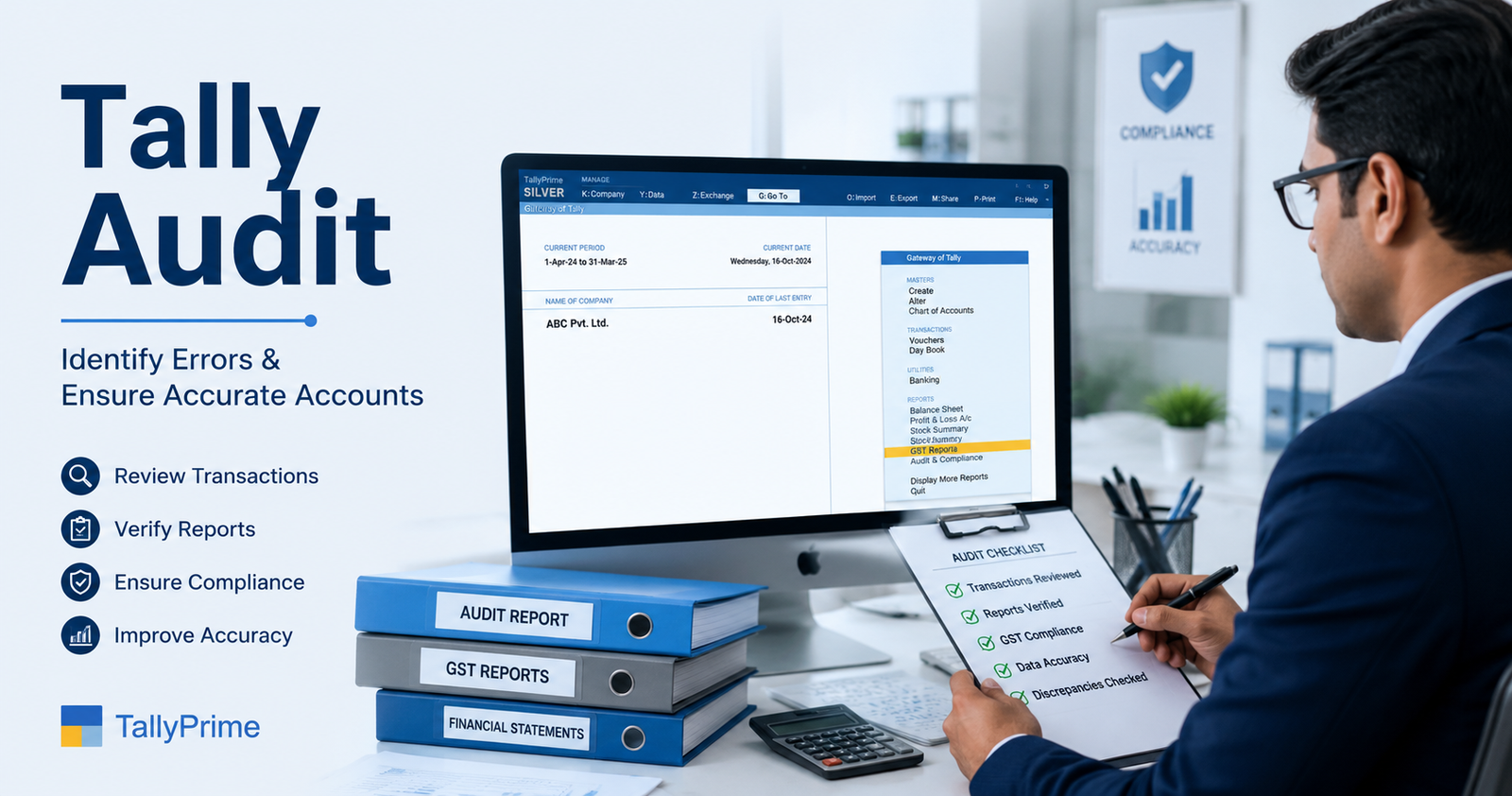
Every year, thousands of Indian businesses go through a statutory audit — yet many business owners don't fully understand what the auditor's final report actually says. An audit report is far more than a year-end formality. It is an independent expert's written opinion on whether your financial statements give a true and fair picture of your business's financial health.
Whether you are a growing startup, an established SME, or a listed company, understanding the type of audit opinion you receive — and what it signals to banks, investors, and regulators — is critical to protecting and growing your business.
This guide breaks down all four types of audit reports issued in India, the legal framework behind each one, and how TallyPrime can help you stay audit-ready throughout the year.
1. What Is an Audit Report?
An audit report is an official written opinion issued by an independent statutory auditor after examining a company's financial records and statements. The auditor reviews documents such as the profit and loss account, balance sheet, accounting records, notes to the accounts, cash flow statement, and all supporting documents.
After reviewing these records, the auditor states whether the financial statements are reliable or whether there are any discrepancies or misrepresentations by the company's management.
Audit reports in India are governed by:
- Section 143 of the Companies Act, 2013 — powers and duties of auditors
- Section 145 — auditor signing requirements
- Companies (Audit and Auditors) Rules, 2014
- ICAI Auditing Standards — especially SA 700, SA 705 & SA 706
- CARO 2020 — for applicable classes of companies
Depending on the audit findings, an auditor may issue one of four main types of opinions. Each carries a very different message for stakeholders.
| Opinion Type | What It Means | Severity |
|---|---|---|
| Unqualified | Financials present a true and fair view | ✓ Clean |
| Qualified | Generally fair, but one specific material issue exists | ⚠ Moderate |
| Disclaimer | Auditor unable to form an opinion due to insufficient evidence | ⚠ Serious |
| Adverse | Financials do NOT present a true and fair view | ✗ Critical |
2. Unqualified Opinion — The Clean Audit Report
An unqualified audit report, also known as a clean audit opinion, is the best outcome a business can receive. It means the auditor found that the company's financial statements give a true and fair view of its financial position and comply fully with applicable accounting standards and legal requirements.
When Is It Issued?
The auditor issues an unqualified opinion when:
- Proper books of account are maintained throughout the year
- All sales, purchases, and expenses are correctly recorded
- The company follows Indian Accounting Standards (Ind AS / AS)
- No major discrepancies or omissions are found during review
- Financial statements reflect a true and fair view of affairs
Example Statement
For XYZ Pvt. Ltd. — which maintains proper books of account, records all transactions correctly, and follows Indian Accounting Standards — the auditor would state:
"In our opinion, the financial statements provide a true and fair view of the state of affairs of the company."
This is the statement every business owner wants to see. It signals credibility to lenders, investors, and regulators.
3. Qualified Opinion — A Specific Issue Exists
A qualified audit opinion is issued when the auditor believes the financial statements generally present a true and fair view, but has identified one specific material matter that prevents a fully clean opinion. Think of it as: "mostly fine, except for this one thing."
Governing Standard
This is governed by SA 705 (Revised) – Modifications to the Opinion in the Independent Auditor's Report, issued by ICAI under Section 143(10) of the Companies Act, 2013.
When Is It Issued?
A qualified opinion is given when:
- There is a material misstatement in a specific area of the financial statements, OR
- The auditor could not obtain sufficient audit evidence on a specific area
- The issue is material but not pervasive — it affects only part of the accounts, not the entire financial statements
Real-World Example
A company shows ₹12 lakh as receivable from a customer who has permanently shut down, but no bad-debt provision has been made. The auditor believes this amount may not be recoverable. The auditor would state:
"In our view, subject to the potential impact of the issue outlined in the Basis for Qualified Opinion section, the financial statements present a true and fair picture of the company's financial position and performance."
4. Disclaimer of Opinion — Cannot Form a View
A Disclaimer of Opinion is issued when the auditor simply cannot gather sufficient and appropriate evidence to evaluate the company's financial statements and is therefore unable to express any reliable opinion at all.
When Is It Issued?
- Accounting records are incomplete or entirely missing
- Management refuses to provide documents requested by the auditor
- Critical inventory or major transactions cannot be physically verified
- There is major uncertainty affecting the accounts (e.g., pending litigation, force majeure events)
Real-World Example
A company's stock worth ₹10 crore is destroyed in a flood and no stock records or insurance papers are available for verification. Since the financial impact cannot be reliably checked, the auditor issues a disclaimer of opinion — they simply cannot confirm whether the financial statements are accurate.
A disclaimer is a serious warning flag for lenders and investors. It often signals poor record-keeping or management co-operation issues.
5. Adverse Opinion — The Most Serious Red Flag
An adverse opinion report is the most serious type of modified audit opinion issued by a statutory auditor. It means the auditor has concluded — with sufficient evidence — that the company's financial statements do not present a true and fair view because the misstatements are both material and pervasive.
Material vs. Pervasive
Material means the issue is significant enough to influence a user's decision. Pervasive means it affects the financial statements as a whole — not just one isolated area.
When both conditions exist together and management refuses to correct the misstatements, an adverse opinion is unavoidable.
Real-World Example
XYZ Ltd. omits a ₹50 crore loan from its books to make its liabilities appear lower and profits appear higher. If that omission is material and pervasive — affecting the overall financial picture — and management still refuses to correct it, the auditor must issue an adverse opinion.
An adverse opinion can trigger loan recalls, loss of investor confidence, regulatory scrutiny, and in severe cases, legal proceedings. It is the outcome every business must work to avoid.
6. Other Important Sections of an Audit Report
Beyond the primary opinion, modern audit reports for certain companies include additional sections that readers must understand.
Key Audit Matters (KAM)
For listed entities and certain large companies, auditors highlight areas that required significant attention during the audit. Common KAMs include:
- Revenue recognition policies and judgements
- Valuation of investments or goodwill
- Pending litigation and contingent liabilities
- Impairment testing of assets
- Related-party transactions
Emphasis of Matter
This draws attention to an important issue already disclosed in the financial statements. It does not change the audit opinion but highlights something the auditor believes users should note carefully — such as ongoing legal disputes or uncertainty about business continuity.
Other Matter Paragraph
This refers to details not mentioned in the financial statements but relevant for understanding the audit or the auditor's responsibilities. For example, the auditor may reference work done by another auditor on a subsidiary or branch office.
Why Choose Us?
Get full access to TallyPrime premium features for 7 days, completely free.
Audit-Ready Books
Maintain accurate records that pass any audit without last-minute panic
No Credit Card
Start your free trial instantly without providing payment details
Expert Support
Our dedicated team helps you set up and stay compliant
Cancel Anytime
No hidden charges or long-term commitments required
7. Why Audit Reports Matter for Your Business
Many business owners treat the audit as a once-a-year chore. In reality, your audit report travels far beyond your finance team — it influences critical decisions made by banks, investors, partners, and regulators.
| Stakeholder | How They Use Your Audit Report |
|---|---|
| Banks & Lenders | Assess creditworthiness before approving loans or overdraft facilities |
| Investors / VCs | Verify financial health before committing capital or equity |
| Vendors & Suppliers | Evaluate payment reliability before extending credit terms |
| Regulators (MCA / SEBI) | Monitor compliance with Companies Act and listing requirements |
| Tax Authorities | Cross-reference reported income with filed returns |
8. Stay Audit-Ready Year-Round with TallyPrime
The single most effective way to ensure a clean audit report is to maintain organised, accurate financial records throughout the year — not just in the weeks before your auditor arrives.
How TallyPrime Prepares You for a Clean Audit
- Double-Entry Accounting: Every transaction automatically updates all ledgers, P&L, and Balance Sheet — no manual reconciliation needed
- Automated GST Compliance: Correct tax rates applied at the point of invoicing, with ready-to-file GSTR-1 and GSTR-3B reports
- Audit Trail: A complete, tamper-proof log of who created, altered, or deleted any transaction — exactly what auditors look for
- Bank Reconciliation: Match your books with bank statements in minutes, not days
- Financial Reports on Demand: Balance Sheet, Trial Balance, and P&L available instantly at any point in the year
- CARO 2020 Reporting: Built-in support for mandatory CARO reporting requirements for applicable companies
When your books are maintained correctly in TallyPrime every day, there are no last-minute surprises for your auditor — and no reason for anything other than a clean, unqualified opinion.
Conclusion
A clear audit report is not just a year-end formality — it is a reflection of how well your business manages its finances every single day. Understanding the difference between an unqualified opinion, a qualified opinion, a disclaimer, and an adverse opinion gives you the knowledge to act on audit findings quickly and protect your business's reputation with lenders, investors, and regulators.
Make it a habit to review audit observations closely, act on gaps quickly, and keep financial records organised throughout the year instead of waiting for audit season.
Using TallyPrime can make this process much smoother — helping your team stay audit-ready, improve accuracy, and respond faster when auditors or stakeholders need information.